EU5 Institutions Explained
The Ages article on this site ended by explicitly deferring this topic. It said a full breakdown of institutions was out of scope, that it was a reference-table task best left to its own article. This is that article. It also closes a functional loop the Ages piece could only gesture at: institutions are what unlock new advances within an Age, so a reader who understands Ages without understanding institutions only has half the picture of how a country actually progresses technologically. Institutions and Ages are two halves of one tech system, and this is the second half.
One sourcing note worth leading with, because it explains how careful this research has been. The core facts below come from the EU5 wiki’s own Institutions content, cross-checked against three independently published guides from November and December 2025, well after the game’s release. An older Steam Community thread on this general topic initially looked relevant, but it turned out to be about EU4’s institution system specifically, not EU5’s, different terminology, a 2017 date, and EU4’s own app ID. It was excluded rather than blended in. This article covers EU5’s current mechanics, no EU4 leftovers.
The 18 institutions, three per Age
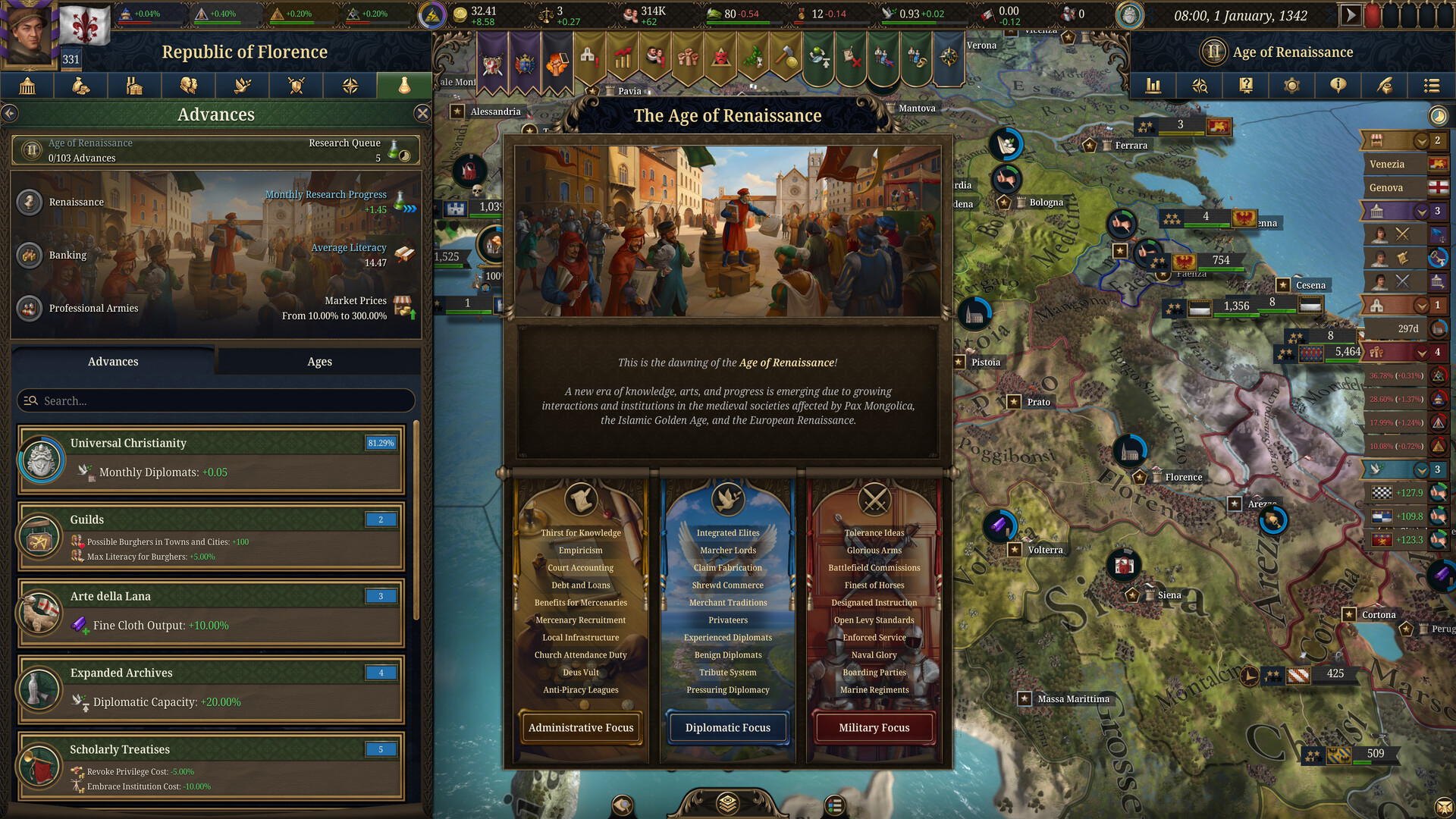
There are 18 institutions total in the game, exactly three for each of the six Ages. Each one is a cultural or technological paradigm shift that appears at a historically fitting location and spreads outward across the map. Once an institution has spread to at least 20% of a country’s population, that country can Embrace it at a cost scaled in Stability and Gold.
The embrace cost has a genuinely useful property: it decreases the more of your country has already adopted the institution naturally. An expensive-looking embrace early gets cheaper the longer you wait, which means rushing to embrace the instant you cross 20% is not always the right call. Sometimes letting the institution keep spreading on its own before you pay is the cheaper play, and the tooltip will show you exactly how much you are saving.
Embracing does two concrete things. It unlocks a brand new branch in that Age’s advance tree, and it doubles the institution’s spread rate going forward. That doubling is the reason institution timing feels so snowbally, the country that embraces first gets its other locations to adopt faster, widening the gap with the country that waits.
Source: Paradox Interactive / Europa Universalis V official screenshots
The Age of Traditions special case
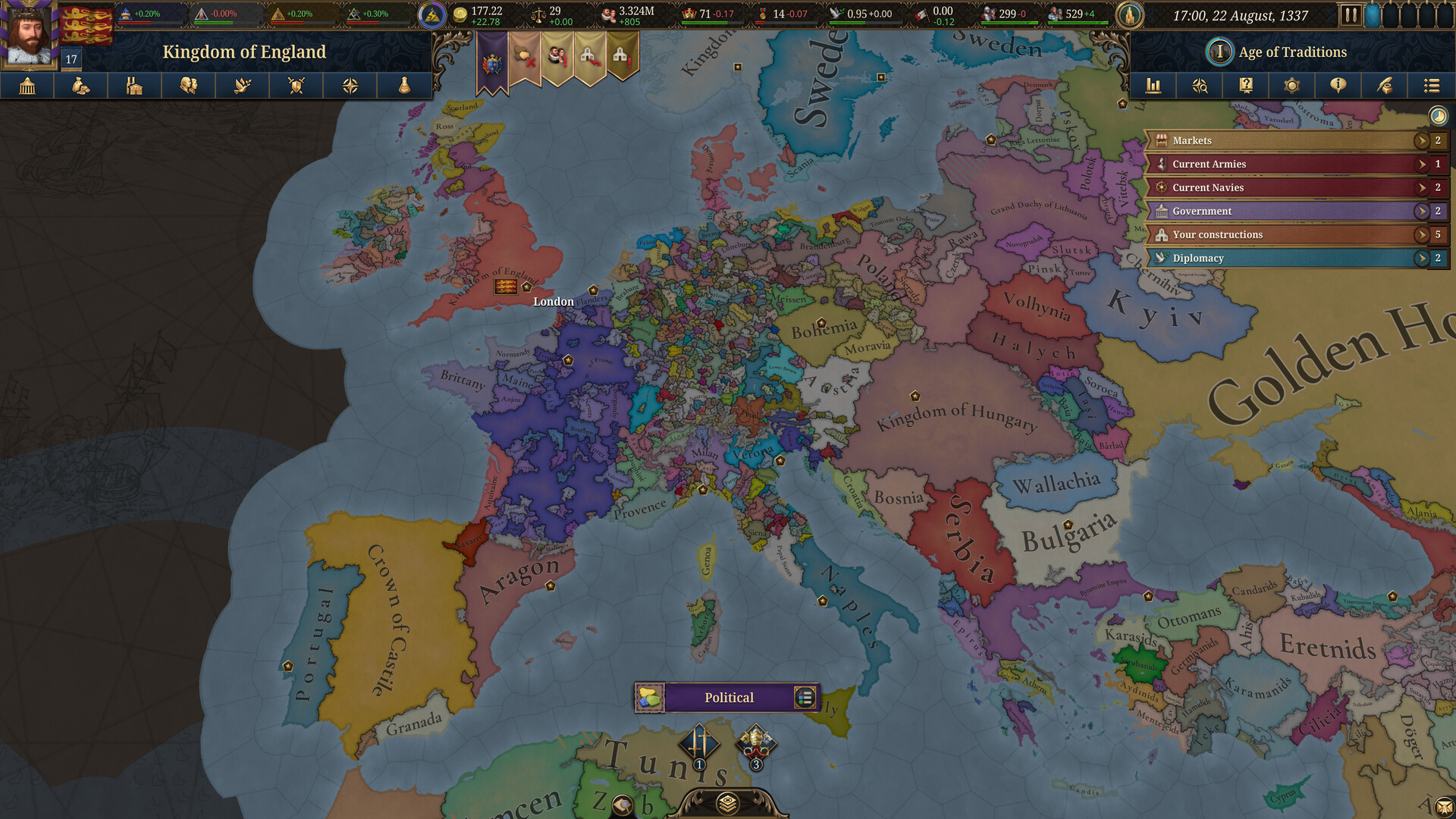
Institutions from the Age of Traditions are a special case: they start the game already spawned and already spread from their historical locations, regardless of the game rules you set. Feudalism begins in Aachen, Legalism in Rome, and Meritocracy in Khanbaliq.
That might read as a small mechanical convenience, but it is actually a subtle worldbuilding choice. The game starts in 1337, and the Age of Traditions is already ending as the campaign begins. Of course those institutions are already widespread, history had been running for centuries before you ever pressed start. The pre-spawned Traditions institutions reflect that the world was already in motion, not that the game could not be bothered to spawn them live. It is a quiet way of telling you that by the time you take control, there is already a rich technological present waiting.
Not every institution can spawn for your country
Here is a real limitation worth stating plainly, because it explains a point of confusion many players hit: later Ages restrict where an institution can even appear, and some nations simply never get a natural spawn point for certain institutions.
Age of Renaissance institutions can only spawn in a location sharing the country’s own primary culture. Age of Reformation and Age of Absolutism institutions are even more restricted, they can only spawn in Europe or North Africa. What that means in practice: if you are playing a nation outside Europe and North Africa, the Reformation and Absolutism institutions never appear on your doorstep by themselves. Your only path is to let them spread in from elsewhere, which is exactly why the embrace threshold and the waiting math matter so much for non-European playthroughs.
This is not a bug and it is not your country being shortchanged. It is an intentional claim about history, the Renaissance genuinely was a European phenomenon, and the institutions that followed it were born in specific places with specific cultural prerequisites. The game is reflecting that geography, not hiding a mechanic from you.
The cabinet can push institutions
Institution management is not purely passive. An advance called Share of Knowledge, available in the Age of Discovery once a country has embraced the Printing Press institution, unlocks a Cabinet Action called Promote Institutions. This lets a country actively push a specific institution’s spread rather than passively waiting for it to arrive.
This is confirmed identically across two independent 2025 guides, so it is solid. It is also worth stating plainly, with a forward link to this site’s Cabinet and Courtiers guide, that institution management is one of the concrete things a cabinet can actively do. When you read about cabinet members being assigned actions, this is a major one: point your cabinet at the institution your country needs most, and it spends its effort spreading it for you.
What actually drives spread rate
Source: Paradox Interactive / Europa Universalis V official screenshots Beyond the embrace math, it helps to know what makes an institution spread faster into your locations. The practical factors, confirmed across multiple sources, are all intuitive once you see them.
An institution spreads faster into locations that are more developed, and faster into locations that are closer to a place that already has it. Friendly borders and coastlines that already host the institution accelerate it, and trade connections through a shared market help too. A more technical secondary source adds that spread also scales with a country’s control over the relevant territory, echoing a point the Ages article already made, that control matters to how institutions behave in your country.
That last one is worth internalizing. Development and proximity you can influence by building and expanding. Control you can lose during wars or unrest. The countries that embrace institutions fastest are not just the ones that happen to sit near where they spawn, they are the ones that keep their territories well-controlled and developed enough for the spread to take root quickly.
This is EU5’s system, not EU4’s
One final clarification, since the mechanics share a name with a familiar older game. EU4 had an institution system too, and it was built on its own rules, its own spawn logic, and its own spread math. This article is specifically about EU5’s current system, which is confirmed by the wiki and by the post-release guides cited above. If you are coming from EU4, treat the similarities as surface-level and relearn the specifics, the example many players trip over is assuming EU4’s insta-reform-spawn behavior or its spawn mechanics carry over, when EU5’s calendar-driven, 20%-threshold, control-scaled system is its own thing entirely.
Source: Paradox Interactive / Europa Universalis V official screenshots
The map is the curriculum
Institutions are where the Age system stops being a timeline and becomes a map. Three per Age, appearing in historically meaningful places, spreading through development, proximity, borders, trade, and control, and usable only once one-fifth of your population has adopted them, institutions are the reason the same calendar makes different countries progress at different speeds. The Ages article gave you the timeline. This article gives you the geography. Together they are the full picture of how technological progress actually moves in EU5, and how a country either rides that current or gets left behind by it.