EU5 Most Profitable Buildings and Best Trade Goods to Produce (Patch 1.4)
This EU5 most profitable buildings guide is written for patch 1.4, with the building economy verified against the current wiki. Most money guides on the internet were written before the current profit model, and following them means building stuff that quietly loses money. This one walks you through how building profit works now, then how to spend your gold in each era.
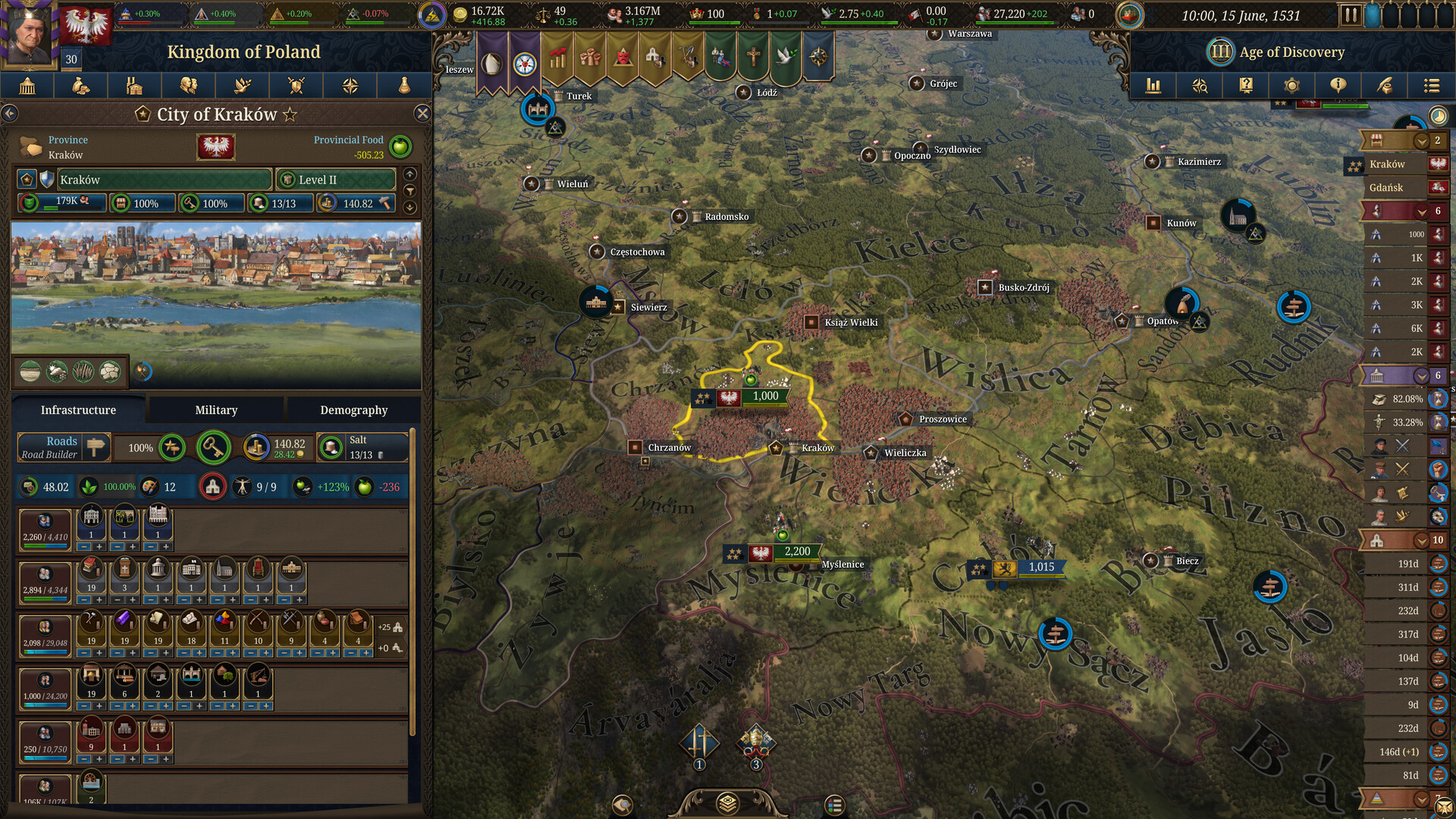
Source: Paradox Interactive, official EU5 Steam screenshot
What 1.3 changed: margin cuts, establishment, price elasticity
Patch 1.3 reworked building economics, and every money guide written before it is stale. Three changes matter for your wallet:
- Production margins were cut. Workshops that printed money before the patch now need a real market to stay black. The change was noticeable enough that community balance mods have spent their releases undoing it.
- Establishment and price elasticity arrived. Prices are no longer static: the market moves each good’s price by the ratio of effective supply to effective demand, stated plainly in the wiki as (1 + effective supply) divided by (1 + effective demand). Push your own exports onto a market and you can drag the price down yourself.
- Location math got louder. With prices reacting to volume and profit reacting to Market Access, where you build is now half the battle.
The rule to take from it: never start production for a good your target market is already flooded with, and check Market Access before you place anything. If the income side of this is new, EU5 economy basics is the foundation this guide builds on.
How building profit works now
Every building has a Potential Profit, and the game calculates it from three things: how many goods you actually produce, the market price of those goods, and your Market Access in that location. Multiply output by price by market access and you have the number the game is really playing with.
Profit is not automatic. A building with positive potential profit hires workers each month. A building with negative potential profit fires 10% of its employees each month, month after month, until the problem is fixed or the building is empty. You can prop a loser up with subsidies, but subsidies drain your treasury directly.
That is the keyword change: market access and market price decide everything now. A great building in a location with no Market Access can lose money, while a mediocre building sitting on a busy market prints gold. Location beats the building list almost every time.
Building costs by Age
The base cost of a building is locked to the Age that unlocked its advance, and understanding it saves you from building too early:
- Age of Traditions or no advance: 50 gold
- Age of Renaissance: 100 gold
- Age of Discovery: 200 gold
- Age of Reformation: 400 gold
- Age of Absolutism: 800 gold
- Age of Revolutions: 1,200 gold
Some buildings cost four times their base, and construction needs goods on top of gold. Plan around the jump: a building that cost 200 in Discovery costs 400 a century later, so earlier is cheaper for the same building.
Building levels, cap, and why location rank matters
Every location has a Building Levels budget: +1 per point of Development, +25 if the location is a Town, +100 if it is a City, plus +5 if it is a country capital and +5 if it is a market center. Go over the budget and every additional building costs +5% more. That cap is the whole reason you cannot build everything everywhere.
The numbers tell the strategy: one City is worth four Towns of building room, and a capital that is also a market center is a genuinely different building hub. Concentrate your best buildings in locations with high rank and high development, and treat the small settlements as simple producers.
Employment systems and potential profit
Your country picks one of four employment systems, and changing it costs 10 Stability, so pick deliberately:
- Equality: fills buildings evenly. Good for balance, nudges you toward Communalism.
- First Come, First Serve: fills in construction order. Simple and predictable.
- Most Profitable First: feeds the best buildings first. The right default for a money run.
- Infrastructure, then Most Profitable: same, but infrastructure first.
For a profit-focused campaign, Most Profitable First is the setting you want. It is the only one that actively routes your workers to the buildings that pay, which compounds over decades. The societal value drift each system adds is worth watching, since dragging your country 20 points toward one value can change your whole food balance.
Early game buildings (Traditions and Renaissance)
Early game you are short on gold and workers, so the winners are the buildings that need almost nothing and pay in food or basic goods.
- Food-producing buildings first. Food security is a prerequisite for everything else, and food shortages punish your growth rate directly.
- Cheap Tradition-era buildings that sell into a market you already have access to. At 50 gold base cost, a building that matches your RGO output pays back fast.
- Skip expensive Renaissance economy buildings until your Market Access in the location is solid. A 100 gold building in a dead market is a 100 gold mistake.
Mid game buildings (Discovery and Reformation)
This is where specialization starts paying. The confirmed levers are Urban Rights and trade goods:
- Back the goods your country naturally produces. A location sitting on a good RGO should get the building that refines and sells that good, not a random luxury.
- Watch input goods. If a production method needs goods your market does not supply, output drops by the percentage of the missing goods. Feed your own chains before expanding.
- Use your building budget where rank is high. A mid-tier building in a City beats a top-tier building in a hamlet.
Late game buildings (Absolutism and Revolutions)
By Absolutism a building costs 800 gold, and by Revolutions 1,200. Affordability stops being the question; placement takes over.
- Concentrate, do not sprinkle. Your big Cities carry the budget (+100 for a City, +1 per Development, +5 for a capital, +5 for a market center). Every building past the budget costs +5% more, so the fifteenth building in a hamlet is money burned.
- Feed the input chains first. Late production methods pull several inputs. Missing goods cut output by the percentage missing, which turns a premium building into an average one.
- Keep Most Profitable First on. With a mature economy it compounds: workers sit in the buildings that pay while the obsolete ones empty themselves.
- Subsidy is an option, not a habit. Use it to bridge a temporary access problem, never to keep a permanent loser alive.
Best trade goods to produce (and which to avoid)
Base prices decide the ceiling of what a production chain can earn. The top of the board:
| Tier | Goods | Base price |
|---|---|---|
| Top of the board | Gold | 8 |
| High-end refining | Silver, Fine Cloth | 6 |
| Luxury and specialty | Jewelry, Lacquerware, Marble, Pepper, Saffron, Chili, Cloves, Steel, Elephants | 5 |
| Steady middle | Salt, Gems, Pearls, Ivory, Amber, Dyes, Cocoa | 4 |
| Volume tier | Cloth, Coffee, Tobacco, Iron, Cotton | 3 |
| Input-only zone | Clay, Sand | 0.5 |
The pattern: raw luxury (Pepper, Saffron, Chili at 5) and refined luxury (Fine Cloth at 6, Jewelry at 5) both pay, so process what your land already gives you instead of importing someone else’s raw goods. The two traps are the bottom row and food staples at 1: Clay, Sand and Wheat will not fund an empire on their own. Food is still worth producing, just for security rather than income. And mind the market you sell into: the EU5 trade guide covers how trade power and routes decide who actually gets those prices.
Worked example: one province, fully optimized

Source: Paradox Interactive, official EU5 Steam screenshot
Take Konstantinopolis as a City that is also your capital and a market center: +100 for the City, +5 capital, +5 market center, plus +1 per Development. A 30 Development Konstantinopolis runs a 140 point building budget. Room is not the constraint here. Picking the right production is.
A textile workshop producing Cloth eats 4 Wool at a base price of 2.5 (10 gold of input) and sells 8 Cloth at a base price of 3. The wiki’s rule: selling price equals amount produced, times market price, times Market Access.
- At 90% Market Access: 8 x 3 x 0.9 = 21.6 against 10 input, so potential profit is about +11.6 per cycle. Positive profit hires workers every month, and the building grows itself.
- At 40% Market Access on the same good: 8 x 3 x 0.4 = 9.6 against 10 input, so potential profit is -0.4. Negative profit fires 10% of the staff every month until you fix the access, switch production methods, or eat the losses with subsidies.
Same building, same prices, opposite outcomes. That is why the location check comes before the building check.
FAQ
What is the most profitable building in EU5?
There is no universal winner, because profit is output times price times Market Access minus input cost. The most profitable building is the one your location can feed and sell: high Market Access, inputs your own markets supply, and a rank high enough to hold it.
Which trade goods sell for the most?
Gold tops the board at 8, followed by Silver and Fine Cloth at 6. The tier at 5 is Jewelry, Lacquerware, Marble, Pepper, Saffron, Chili, Cloves, Steel and Elephants.
Why is my building losing money?
Almost always one of two things: poor Market Access dragging the selling price down, or missing input goods cutting output by the missing percentage. Check both before you blame the building.
Should I subsidize a losing building?
Only as a bridge. Subsidies stop the monthly firing of staff, but the negative potential profit comes straight out of your treasury every month until the underlying problem is fixed.
What should I read next?
Start with EU5 economy basics if the income model is still fuzzy, then the EU5 trade guide for selling what you produce, and when you need gold now rather than later, our EU5 loans and government bonds guide covers borrowing properly.