EU5 Ages Explained
Four articles on this site have opened loops that only make sense once you know what an Age is. The Political Influence guide described the Absolutism versus Liberalism societal value axis granting monthly Political Influence at both extremes, without ever saying when that axis becomes available. The Societal Values guide noted that some axes are gated by Age without explaining what an Age actually is. The Government Types guide mentioned Age-gated reforms without a number. And the Sieges and Combat guides describe mechanics that shift meaningfully across eras, including the fact that war score gained from battles drops in later Ages. This article is the timeline the rest of the political and military cluster runs on, and it is long overdue.
One confidence note up front. The numbers in the first half of this article come directly from the EU5 wiki’s Age pages, several of which cite the game’s own internal code constants rather than player tests or forum guesses. That is about as primary a source as this project has ever had, so the research costs, start years, and institution rules below are written with confidence. A second set of figures later in the article comes from Paradoxpedia, a separate reference site, and it is exactly as solid, but it is still a secondary source, so those numbers are flagged as such rather than presented with the same certainty.
Institutions unlock new branches
Each Age introduces three Institutions that appear at historically fitting locations and spread outward along trade routes and borders. They are the game’s way of making knowledge geographic, a discovery in Venice is not a discovery in London until it travels there.
Once an Institution has spread to roughly one-fifth of a country’s territory, that country can Embrace it at a cost scaled in Stability and Gold. The exact threshold is a game-code constant, around 20%, rather than a number displayed prominently in the UI, so check your own institution panel before planning around it. Embracing does two clear things: it unlocks a brand new branch in that Age’s advance tree, and it doubles the Institution’s spread rate going forward. The spread bonus even has a caveat, if you lack control over the relevant territory, the doubling shrinks.
The practical shape of this is that each Age is really three institutions, three new research branches, and three spread timers running in parallel. A country that embraces institutions early researches more of its Age’s tree; a country that ignores them falls behind on the same calendar everyone else shares.
The direct callback: Age of Absolutism
The Age of Absolutism, starting in 1637, is the specific era that unlocks the Absolutism and Liberalism societal values. That is the same axis the Political Influence article described as granting monthly Political Influence at both extremes, and this article should settle what that article left open: that axis does not exist from turn one. It becomes available only once a country reaches this specific Age.
That reframes a detail you may have misread. The Political Influence guide’s mention of the Absolutism versus Liberalism axis sounds like something you could engage with in 1337, but it is actually a 17th-century option, gated behind a century and a half of calendar before a single law can touch it. Locking a prominent-sounding mechanic behind an era is a genuinely interesting way to keep the early game feeling different from the late game, but it is the kind of thing that can silently mislead a new player who assumes every listed resource is available from day one.
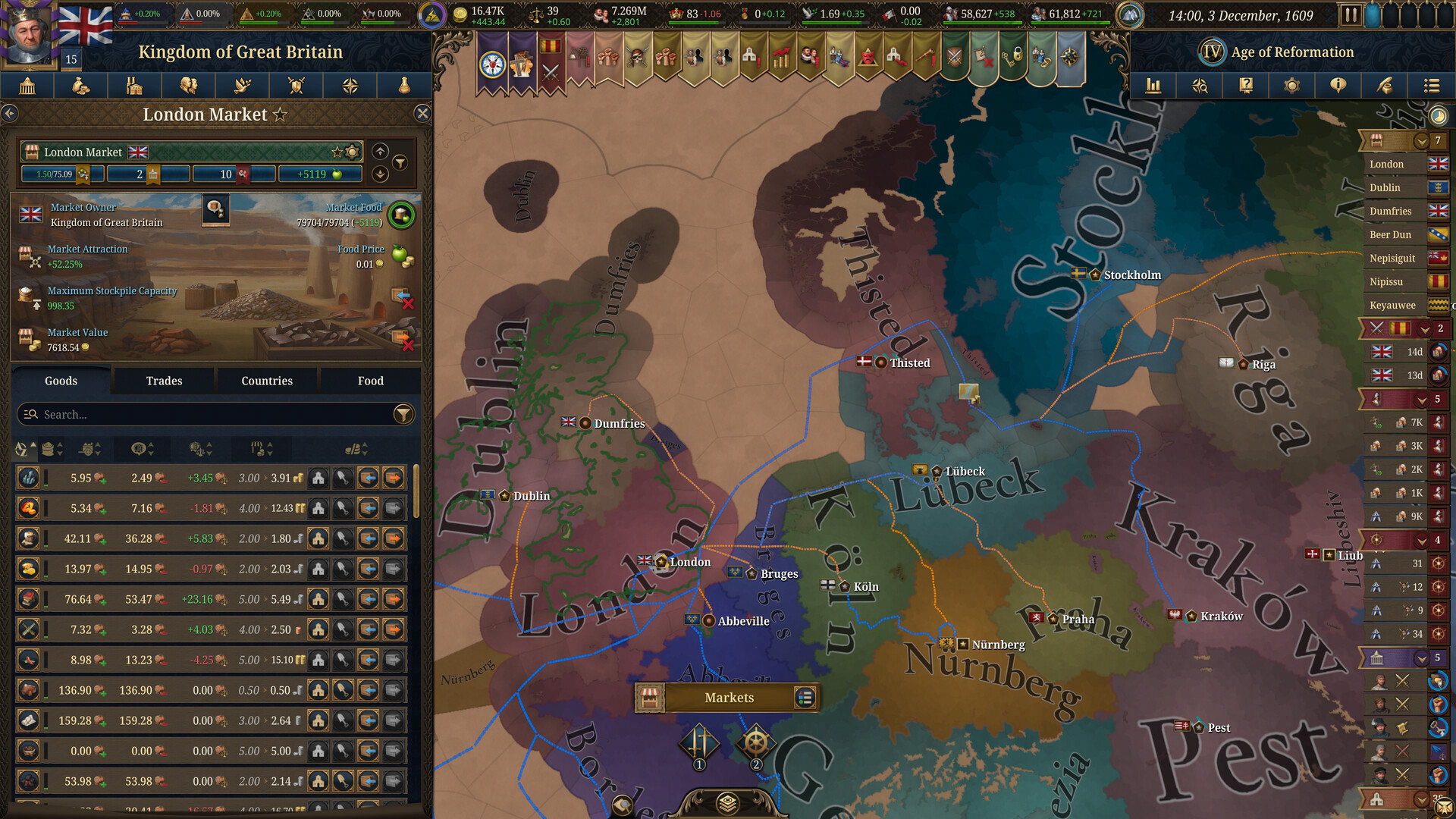
The Age of Absolutism also shifts the economy. It raises the maximum market price ceiling to 500% and holds market price stability at 4%, which matters if you are used to earlier Ages with tighter price bands and more volatile markets. Markets in the Age of Absolutism can swing much further before they hit a cap, which changes how aggressive you can be with trade-heavy economies.
Source: Paradox Interactive / Europa Universalis V official screenshots
Broader shifts across the Ages
Beyond the wiki-confirmed mechanics, a secondary reference site, Paradoxpedia, catalogs several structural shifts across the Ages that are worth carrying into your planning. These are flagged as secondary because they come from that reference rather than the wiki’s own numbers, but they are consistent with everything else on this page.
The Hegemon system, where the great power leading in a given field can be proclaimed Hegemon and earn bonuses, only becomes available in 4 of the 6 Ages. It is not a permanent feature of the late game.
Mercenary availability shrinks substantially in later Ages, down to around a 90% reduction by the latest ones. If your early game relies on buying armies, expect that option to be almost gone by the late game, a real planning consideration most players do not start budgeting for.
War score gained from actual battles decreases in later Ages, by as much as 80% at the far end. That shifts the practical emphasis toward occupying territory directly rather than winning field battles, which is a genuinely useful strategic note to connect back to the Sieges article, since sieges and occupation are exactly how that occupation-first strategy executes.
And the direct, quantified version of what the Government Types article gestured at without a number: roughly 130 government reforms require reaching a specific Age before they are available at all. Your government’s reform pool is not static, the calendar quietly unlocks most of it over time.
The calendar is a silent co-governor
The Ages are the least talked about, most load-bearing structure in EU5. Political Influence’s most distinctive societal value axis is locked behind the Age of Absolutism. Societal values are gated by era. Government reforms are gated by era. Even war strategy shifts with the Ages, from battles toward occupation as the centuries roll forward. Every one of those is a loop this site opened in another article, and this is the timeline that closes them.
The practical read is a quiet one. You cannot opt out of the Ages and you cannot speed them up, so the winning move is to plan with them instead of against them. Bank research before an Age turns. Embrace institutions to keep your advance tree open. Know that the Height of Absolutism is where the political systems really open up, and know that by the Age of Revolutions, mercenaries and battle-based war score will not carry you the way they did at the start. The calendar is the silent co-governor of every campaign, whether you were paying attention to it or not.

Source: Paradox Interactive / Europa Universalis V official screenshots
The six Ages, and the calendar you cannot argue with
EU5 runs on six Ages: Traditions, Renaissance, Discovery, Reformation, Absolutism, and Revolutions. They begin respectively in year 1, 1342, 1437, 1537, 1637, and 1737, and each lasts roughly a century.
The structural fact worth stating plainly: every country transitions between Ages at the same moment, the instant the game clock hits that year. This is not something an individual country can rush, delay, or opt out of. There is no button that hurries your realm into the Renaissance and no lever that holds it back in Traditions. You do not choose when your country enters the next Age, the calendar does, and it does so for every nation on the map simultaneously.
That simultaneous transition is more than trivia. It means every realm is researching under the same constraints at the same time, and the relative advantages of being early or late to an Age are locked in by the world clock, not by player skill.
Each Age, you pick a Focus
At the start of every Age after Traditions, a country selects one of three Focuses: Administrative, Diplomatic, or Military. That single choice determines the actual shape of the advance tree available to research for the entire Age.
This is a real, once-per-Age strategic decision, not a minor toggle. Pick Military for the Age of Discovery and your available advances skew toward martial options for the whole era; you are not revisiting that choice until the next century turns over. And if the three-way Administrative, Diplomatic, Military split sounds familiar, it should, the same division already runs through how governments are built and how Political Influence is spent. The Age system is echoing a core design rhythm the rest of the game shares.
Source: Paradox Interactive / Europa Universalis V official screenshots
How research actually works
The research system sits on top of the Ages, and its numbers are wiki-confirmed. The base cost for any advance is 25 Research Progress. Each Age after Traditions adds a cumulative 15% to that base cost, so Renaissance-era advances cost 15% more, scale up from there, and reach a full 75% more by the Age of Revolutions.
There is a partial offset worth knowing. Once a country has moved into a new Age, advances left over from previous Ages get a flat discount of 8 Research Progress off their cost. Finishing your Traditions-era backlog in the Renaissance is cheaper than it would have been while it was current, which quietly rewards clearing old trees rather than abandoning them.
A country not actively researching anything can stockpile up to 12 months of research progress, and that banked value carries straight into the next advance you start. This is the number worth remembering if you are tempted to glance at research as a pure on/off: pausing research briefly is not a wasted opportunity. It banks. Twelve months of stored progress is waiting for you the moment you pick something to spend it on.