EU4: How to Become Holy Roman Emperor (Every Path Explained)
Becoming the Holy Roman Emperor is one of the most popular questions EU4 players have asked since the game launched in 2013. It is also one of the hardest to answer well, because there is no single shortcut. The Empire is genuinely complex: seven electors vote the Emperor in, Imperial Authority decides how much the crown actually matters, and the Reformation can knock the whole thing sideways. This guide walks through every confirmed path, from buying your way onto the electoral college to dissolving the map entirely with Renovatio Imperii.

Source: EU4 Wiki / Paradox Interactive (Holy Roman Empire page, image used for educational commentary) The Emperor game depends heavily on government reforms and understanding how estates and crownland shape your realm, so those guides pair well with this one.
Becoming an Elector: the three gateways
You cannot vote for yourself until you are one of the electors. The HRE defaults to a maximum of seven electors, and there are three ways to become one.
Purchase the Electorate. If you are allied to the current Emperor, you can buy electoral status for 6,000 ducats. This is the most straightforward path, but 6,000 ducats is a serious investment for most nations, and being allied to the Emperor while also positioning to take his crown is a delicate balance.
Request the Electorate. If your relations and trust with the Emperor are high enough, you can simply ask. There is no gold cost, but you need a genuinely strong relationship, and the Emperor has to be willing to give a rival contender a vote.
Seize it by force. If you are strong enough to enforce the issue, an electorate can be taken directly. This is the bluntest option, and while it skips the diplomacy entirely, it puts you at war with the Empire’s structures and turns the current Emperor into an immediate enemy.
There is also a tidy achievement tied to this milestone: “Electable!” unlocks specifically for becoming an elector, which makes it a satisfying box to tick even if you never intend to push for the crown itself.
Winning the Election Itself
Electors vote when the current Emperor dies. Their choice is shaped by a bundle of factors, and every one of them is worth managing:
- Relations with each elector
- Imperial Authority
- Prestige
- Legitimacy
- Country size
- Trust
- Religion
No single factor wins the vote on its own. A small, religiously suspicious nation with great relations can still lose to a large, prestigious rival the electors simply fear more.
Imperial Authority is the currency that makes the crown worth holding. It is gained slowly but steadily:
- A baseline of +0.10 per year while the Empire is at peace
- +0.004 per prince for every prince above 25
- Imperial Incidents, which resolve based on support: 0.2 Authority per supporting prince and 1 per supporting elector
The religion of the Emperor matters throughout. The crown is expected to stay Catholic, or at minimum to end up on the winning side when religious conflict splits the Empire. Rulers who bet wrong on religion can find themselves ineligible until the Peace of Westphalia rewrites the rules.
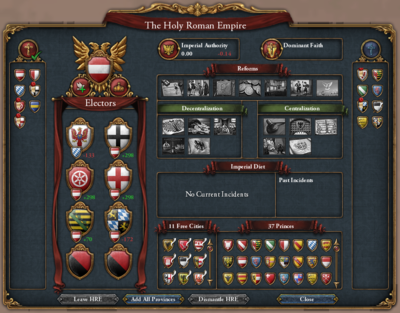
Source: EU4 Wiki / Paradox Interactive (Holy Roman Empire interface image, used for educational commentary)
The Paths in from Outside the Empire
If your country starts outside the HRE entirely, there are still routes to the throne.
Marry into an elector’s family. A royal marriage with an elector’s ruling house builds an inheritance claim over time. If your dynasty ends up inheriting the electorate itself, you become an elector without ever setting foot in the Imperial politics you would otherwise need to charm your way through.
Usurp an electorate through a subject. If you hold an elector as your subject, you can press the point and take the electorate directly. It is a brutal shortcut, but it works, and it is the path favored by larger powers who would rather absorb the Empire piece by piece than court its approval.
There is a gentler door as well. Any sufficiently respected Christian power can request to join the Empire directly when relations with the Emperor reach +190, and joining puts you inside the system where the election happens.
Free Imperial Cities, and Why an Emperor Cares About Them
The Emperor can appoint up to 12 Free Imperial Cities (the ability requires the Common Sense DLC). They are typically one-province minors, they receive special Imperial protections, and they give the Emperor additional Authority while they exist. They can never become electors themselves, so they are a quiet source of strength rather than a political threat.
Every Free Imperial City in place means more Authority ticking your way, which is the resource the entire Imperial reform track runs on.
The Endgame: Renovatio Imperii
The long-term payoff for all of this is the reform line that ends the map. If you hold the Emperor title, raise Imperial Authority high enough to pass the reforms, and reach the final one, Renovatio Imperii unifies the entire Holy Roman Empire into a single country: the Roman Empire. The HRE stops being a loose patchwork of princes and becomes your realm outright.
It is the most European-mid-game-ending achievement the game offers, and it is the reason so many players spend fifty years managing electors they could have simply conquered. Every path in this guide feeds that single decision: become an elector, win the crown, raise the Authority, and then decide whether to rule the Empire or dissolve it into something greater.