EU4 Government Reforms: All 12 Tiers & Best Picks
Government reforms are one of those EU4 systems that seems complicated at first but is actually pretty straightforward once you understand it. They’re essentially a tech tree for your government. You earn reform progress over time, and you spend it on reforms that give you permanent bonuses and unlock new mechanics. Here’s how it all works.
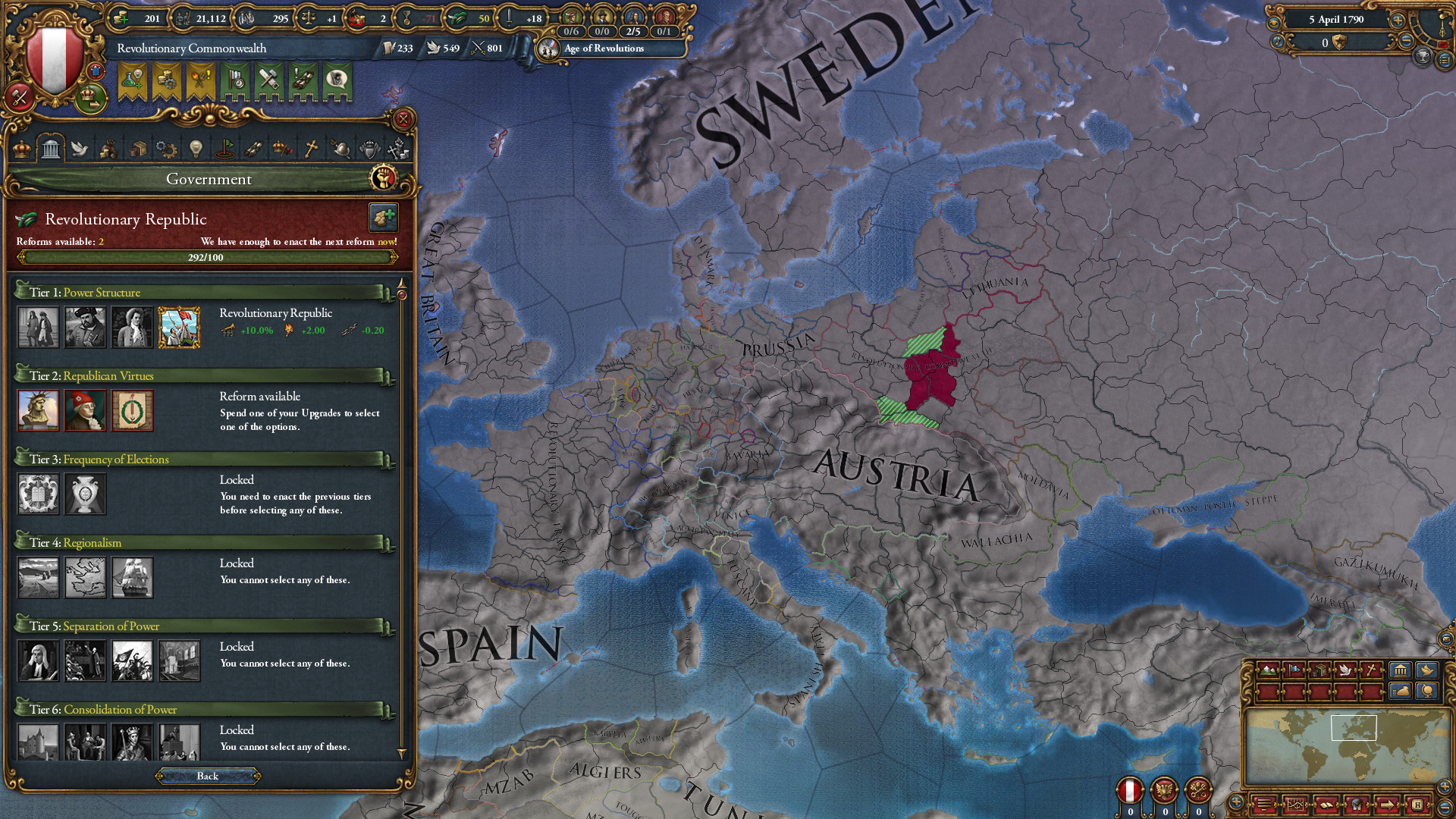
Source: Paradox Interactive / Europa Universalis IV official screenshots Government reforms shape everything else in your campaign, from the estates and crownland system to your path to the Holy Roman Emperor title.
The Basics
Every nation in EU4 has a government type: monarchy, republic, theocracy, tribe, and so on. Government reforms are a set of tiers (1 through 12) that you progress through over the course of the game. Each tier has a choice of reforms, and each reform gives you a permanent bonus.
You earn reform progress passively over time. The rate depends on your government type and a few other factors. You can also get reform progress from certain events, ideas, and decisions. Once you have enough progress, you can pick a reform from the next tier.
The Reform Tiers
The tiers are numbered 1 through 12, and they unlock as the game progresses. Higher tiers are locked behind both reform progress and, in some cases, the in-game date. You can’t rush to tier 12 in the first 50 years. The game gates it.
Each tier offers a choice of reforms, and the choices are usually themed around your government type. A monarchy might choose between different types of royal courts or administrative structures, while a republic might choose between different electoral systems. Some reforms are clearly better than others, and some are situational.
Choosing Reforms
The key to picking reforms is understanding what fits your playstyle:
Early tiers (1-3). These shape your government’s foundation. For monarchies, you’re choosing between reforms that boost legitimacy, prestige, or administrative efficiency. For republics, you’re choosing between electoral systems and civic structures. Think about whether you’re playing tall (development, trade, economy) or wide (conquest, expansion, military).
Mid tiers (4-7). This is where reforms start having a bigger impact. You’re choosing between options that affect your economy, your military, or your internal management. If you’re playing a conquest-heavy campaign, prioritize reforms that boost your military or administrative efficiency. If you’re playing tall, look for reforms that boost development or trade.
Late tiers (8-12). These reforms are powerful but come late. They can completely transform your nation, so plan ahead. Some reforms unlock special government mechanics that change how your nation plays.
Reform Progress Tips
Getting reform progress faster means getting your reforms sooner. Here’s how to speed it up:
- Pick the right government type. Some governments generate reform progress faster than others. Republics and theocracies generally get more than monarchies.
- Take ideas that boost reform progress. The Administrative idea group has a reform progress bonus, and some national ideas do too.
- Watch for events. Several events give you reform progress as a reward. It’s usually worth taking the reform progress over the alternative.
- Don’t reform too early. This sounds counterintuitive, but some reforms have downsides. Read the tooltip carefully before you pick. A reform that looks good on paper might hurt your playstyle.
The Absolutism Connection
Government reforms interact with absolutism, which is a late-game mechanic that boosts your administrative efficiency. Some reforms give you absolutism bonuses, and having a high reform tier makes it easier to reach high absolutism. If you’re planning a late-game conquest campaign, pay attention to reforms that boost absolutism.
Government reforms are a system you’ll interact with throughout the entire game, but you don’t need to stress about them. The key is to understand what each reform does and pick the ones that fit your playstyle. Don’t just pick the first option. Read the tooltips, think about your campaign goals, and choose accordingly.
The system rewards planning. If you know you’re going to play a tall trade empire, pick reforms that boost trade and development. If you’re planning a world conquest, pick reforms that boost absolutism and administrative efficiency. The reforms are there to support your strategy, not to dictate it.