EU4 Trade Nodes Explained: Interactive Trade Map
I’ve played EU4 for years, and trade has always confused me. For a long time I wasn’t able to take full advantage of it simply because I never had a clear understanding of how it worked. I built this tool to give you a quick visual guide, the kind of thing I wish I’d had, to help you see how trade actually flows in a much easier and more intuitive way.
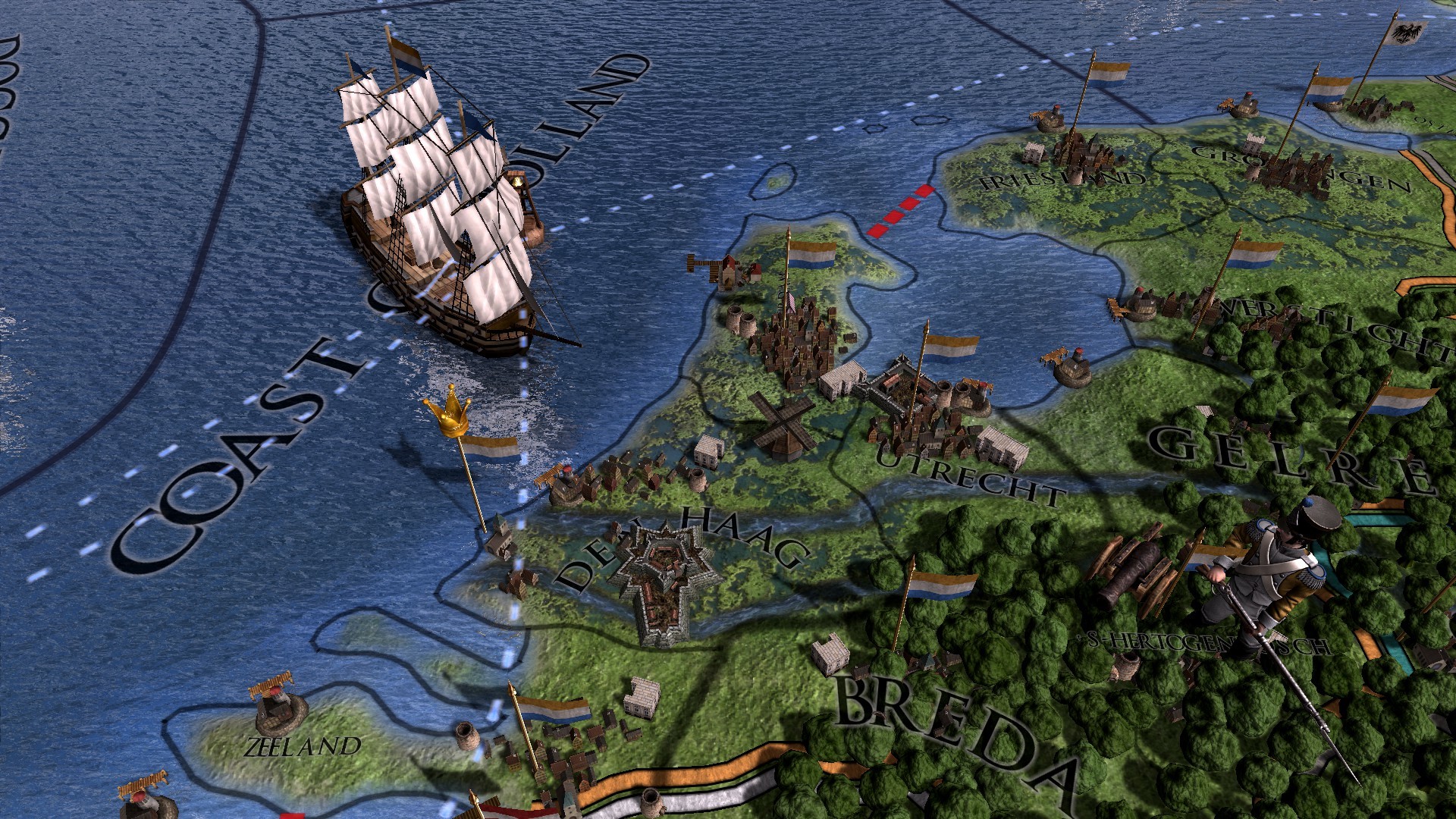
Source: Paradox Interactive / Europa Universalis IV official screenshots
What Are Trade Nodes?
Every province in EU4 feeds its trade value into a trade node. Trade nodes are the hubs of the global economy. They collect value from the provinces around them, and that value either gets collected by a nation with trade power in the node, or it flows onward to the next node.
Think of it like a river system. Provinces are the streams that feed into the river (the trade node). The river flows downstream, and at each junction, the water splits based on how much control each branch has. Some of the water gets diverted (collected by nations), and the rest keeps flowing toward the sea.
The Three End Nodes
The trade network has three end nodes, the “seas” where trade value finally settles:
- English Channel: the richest end node in the game, fed by trade from the New World, Africa, and Northern Europe
- Genoa: the Mediterranean end node, fed by trade from the Middle East, North Africa, and the Atlantic
- Venice: the eastern Mediterranean end node, fed by trade from the Levant, the Balkans, and beyond
Once value reaches an end node, it stays there. It doesn’t flow anywhere else. It just sits, waiting for a nation to collect it. This is why controlling an end node is so powerful: you’re at the end of the line, and everyone’s trade has to pass through you.
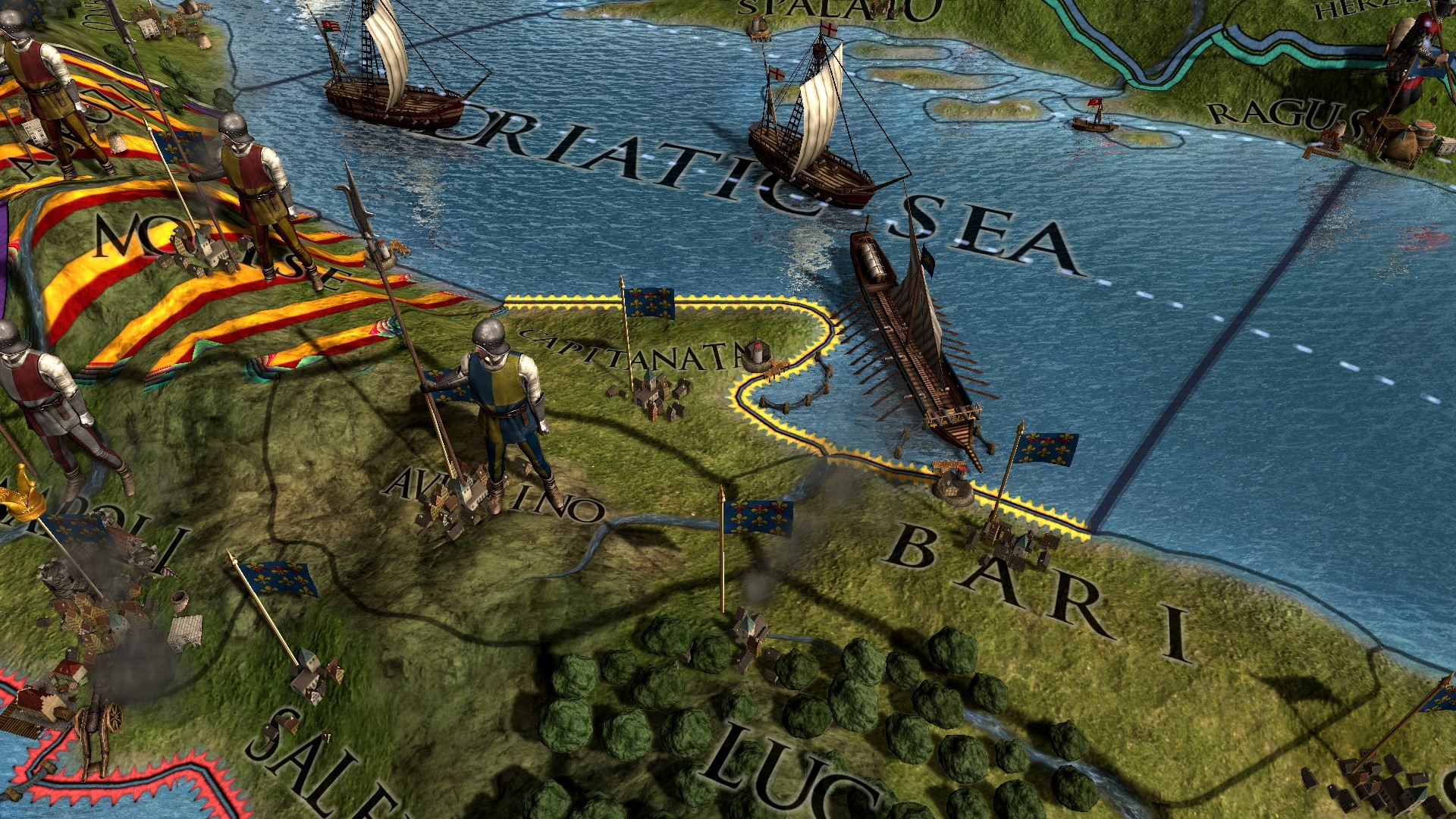
Source: Paradox Interactive / Europa Universalis IV official screenshots
How Value Flows
Here’s the key mechanic that confuses most new players: trade value doesn’t pick one path. It splits across every available route.
If a node has three outgoing connections, the value flowing out of that node splits across all three, proportionally to the trade power each downstream node has. If you control 50% of the trade power in one downstream node, you capture 50% of the value that flows there.
This means:
- Trade power matters everywhere, not just in your home node
- Controlling the path is often as important as controlling the source
- Merchants can steer trade toward your preferred route, but they can’t stop the split entirely
Why This Matters for Your Campaign
Understanding the trade network changes how you play:
1. Your home node is your foundation. The node where your capital sits is where you collect trade. The more trade power you have there, the more of the value you capture.
2. Expand toward the end nodes. The closer you are to an end node, the more value flows through your territory. A nation in the English Channel collects far more than a nation in the middle of the network.
3. Trade power compounds. The more provinces you control in a node, the more trade power you have, which means you capture more value, which means you can afford more provinces. It’s a snowball effect.
4. Don’t ignore upstream. Even if your home node is downstream, controlling key upstream nodes lets you steer more value toward yourself.
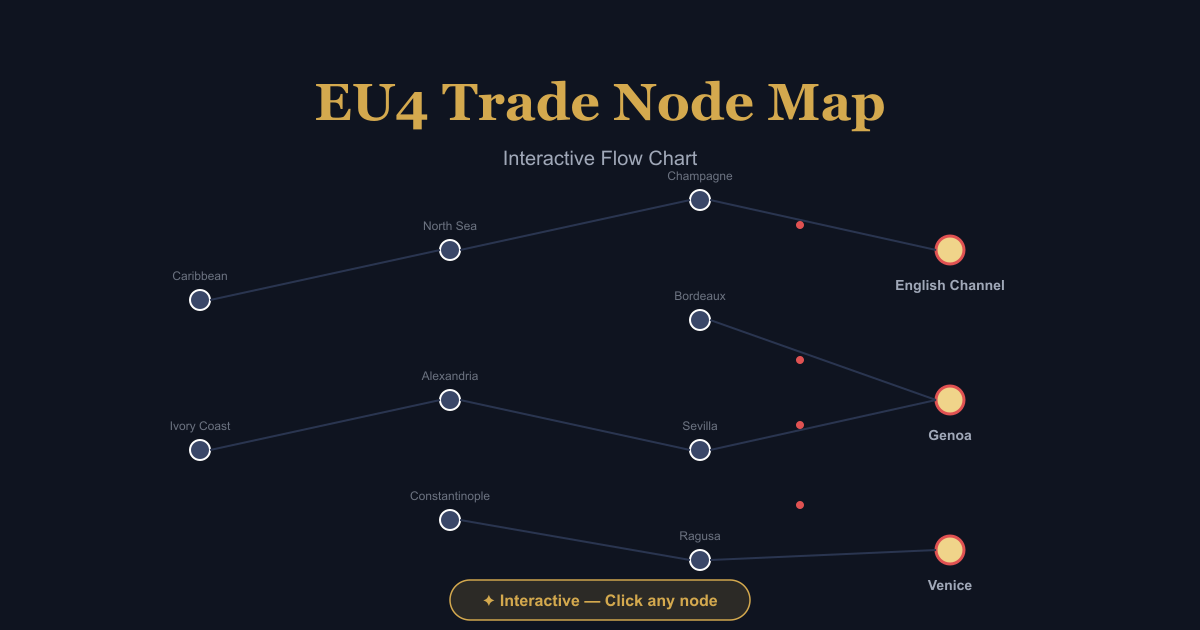
Source: Grand Strategy Hub interactive tool
Explore It Visually
Understanding trade flow from text is hard. It’s a network, and networks are best understood visually. That’s why we built a free interactive tool:
→ Explore the interactive EU4 trade node map
Click any node to see:
- What feeds into it
- Where its value flows
- Which end node it eventually reaches
- How the value splits across routes
The map has four views: Simple (12 key nodes), Europe (29 nodes), Asia (31 nodes), and Global (78 nodes), plus a search function to jump to any node by name.
Trade in EU4 is a network, not a line. Value flows from provinces into nodes, splits across every available route, and eventually settles in one of three end nodes. The nations that understand this network, and position themselves to capture the flow, are the ones that build the richest empires.
If you’ve ever wondered why your trade income is lower than it should be, or why the English Channel is so valuable, the interactive map will show you exactly how it all connects.